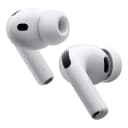
Apple
AirPods Pro 3 with Hearing Aid Feature
FDA-cleared OTC hearing aid software
It's the most common complaint in hearing care: "I can hear that people are talking, but I can't understand the words." That's the signature of high-frequency hearing loss — and it's also the pattern over-the-counter hearing aids are best suited to.
Have a hearing test? The audiogram interpreter reads your numbers and tells you the shape and severity. No test yet? The severity quiz gives a free starting estimate in two minutes.
High-frequency hearing loss means the high-pitched sounds — roughly 2,000 to 8,000 Hz — have faded while your low-pitch hearing stays relatively intact. Those high pitches do most of the work of understanding speech: the consonants (s, f, th, sh, k, t), women's and children's voices, birdsong, and the beep of a microwave. Lose them and speech still sounds present but no longer clear — worse in noise, worse over distance, worse with higher voices.
It is the most common pattern of hearing loss because the two leading causes — aging and noise — both damage the high-frequency end of the inner ear first. The good news: a gentle high-frequency slope in the mild-to-moderate range is exactly what OTC hearing aids are built to correct.
Speech is built from two kinds of sounds. Vowels (a, e, o, u) are low-pitched and loud — they carry the energy and rhythm of speech. Consonants (s, f, th, sh, k, t, p) are high-pitched and soft — they carry the meaningthat tells "cat" from "cap" from "cash." High-frequency loss leaves the loud vowels mostly intact but strips the quiet consonants, so you hear that someone is speaking and can't make out which words. It feels like mumbling, but the volume isn't the problem — the clarity is.
| Pitch | Sounds it carries | With high-frequency loss |
|---|---|---|
| Low (250–1,000 Hz) | Vowels (a, e, o, u), m, n, deeper male voices, the "hum" of speech | Mostly intact — speech still sounds "there" |
| High (2,000–8,000 Hz) | Consonants (s, f, th, sh, k, t); women's & children's voices; birdsong; alarms | Faded or missing — words blur, hardest in noise |
Higher voices live higher on the dial. Women's and children's voices have a higher fundamental pitch and far more energy in the high harmonics that high-frequency loss removes, while men's lower voices stay clearer for longer. If you find deeper voices easy but higher voices sound thin, distant, or muffled, that contrast itself points to a high-frequency pattern rather than an across-the-board volume loss.
Two causes dominate, and they often overlap:
Both damage the hair cells at the base of the cochlea, which respond to high pitches and are the most fragile. That damage is permanent, which is why the goal is to restore the missing sounds with amplification and protect the hearing you still have.
On an audiogram, high-frequency loss is a line that starts near normal on the left (low pitches) and slopes downward to the right (high pitches) — the shape clinicians call sloping or a "ski-slope" loss. The steeper the drop, the more high-frequency hearing is gone. A less common cousin is the "cookie-bite" pattern, where the dip sits in the mid frequencies instead and the very lows and highs are better — that one is more often genetic. If you have your test results, the audiogram interpreter identifies the shape and tells you whether it falls in OTC range.
For most people with high-frequency loss, this is the sweet spot for over-the-counter devices. OTC hearing aids are cleared for perceived mild-to-moderateloss, and a sloping high-frequency loss in that range is precisely what they target — they add gain mainly up high, where you've lost ground, and leave the lows alone. Where OTC stops being the right answer: if your audiogram drops steeply into the severe range (worse than about 70 dB HL) in the high pitches, that can exceed what OTC devices are built to handle, and professional fitting is the better path. Check your mild and moderate picks if you land in range, or use the OTC vs audiologist decision toolif you're on the line. One caution before you buy: see a doctor first if your loss came on suddenly, sits in only one ear, or comes with dizziness or drainage.
For purely high-frequency loss, the ideal style is an open-fit receiver-in-canal (RIC) aid. It places a tiny speaker in the ear canal with an opendome, so it boosts the high frequencies you've lost while letting the low-pitch sound you still hear well pass through naturally. That open design avoids the plugged-up, boomy feeling — the "occlusion effect" — that fully sealed in-ear styles can cause when your low-frequency hearing is fine. Most well-reviewed OTC self-fitting aids use this open-fit RIC approach, which is why they work so well for this pattern.
Open-fit, self-fitting OTC options for perceived mild-to-moderate loss, in ascending price order. Same picks we recommend site-wide; severity fit verified against each product's cleared range.
Apple
At $199-$249 with FDA-cleared hearing aid software (DEN230081), the AirPods Pro 3 turn an iPhone you may already own into a legitimate mild-to-moderate hearing aid. Lowest-risk way to start.
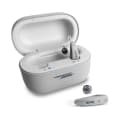
Lexie
Bose-tuned, rechargeable, self-fitting via the Lexie app, with a 45-day trial. $899 — a fraction of the audiologist price for the same mild-to-moderate range.
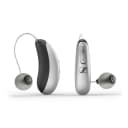
Sennheiser
Built by Sonova (the company behind Phonak), the All-Day Clear is a true QUH self-fit hearing aid with Bluetooth streaming and a 2-year warranty — around $949 street.
Picks are based on FDA regulatory pathway, price, and severity fit from our verified product database — not on which brand pays the most.
High-frequency hearing loss means you've lost sensitivity to high-pitched sounds (roughly 2,000-8,000 Hz) while keeping much of your low-pitch hearing. Those high pitches carry the consonants that make speech intelligible (s, f, th, sh, k, t) plus women's and children's voices and birdsong. The result is the classic complaint: 'I can hear that people are talking, but I can't understand the words' — especially in background noise. It is the most common pattern of hearing loss, largely because aging and noise damage the high-frequency part of the inner ear first.
Women's and children's voices have higher pitch — both a higher fundamental frequency and more energy in the high harmonics that high-frequency hearing loss strips away. Men's voices sit lower in pitch, so they stay clearer for longer. If deeper voices are easy but higher voices sound muffled or distant, that pattern points to high-frequency loss rather than overall volume loss.
It shows up as a sloping line that starts near normal on the left (low pitches) and drops downward toward the right (high pitches) — often called a 'ski-slope' or 'sloping' configuration. A steeper drop means a more severe high-frequency loss. A less common variant is the 'cookie-bite' shape, where the dip is in the mid frequencies instead. Our audiogram interpreter reads your numbers and tells you the shape and severity in plain English.
Often, yes. OTC hearing aids are designed for perceived mild-to-moderate loss, and a gentle high-frequency slope in that range is squarely what they're built to address — they add gain mainly in the high frequencies where you need it. If your audiogram drops steeply into the severe range (worse than about 70 dB HL) in the high pitches, that can exceed what OTC devices are cleared to handle, and professional fitting is the better route. The audiogram interpreter and severity quiz give a free starting estimate of whether you're in OTC range.
An open-fit receiver-in-canal (RIC) style is the usual best match. It amplifies the high frequencies you've lost while leaving the ear canal open, so the low-pitch sounds you still hear well pass through naturally and your own voice doesn't sound boomy or plugged up. Most well-reviewed OTC self-fitting aids use this open-fit RIC approach. Avoid fully occluding in-ear styles for purely high-frequency loss unless a fitting shows you need them.
No. High-frequency loss from aging or noise is sensorineural — it comes from damage to the hair cells in the inner ear, which don't regenerate, so it can't be reversed or cured. It can be managed well with hearing aids that restore the missing high-frequency sounds, and you can protect the hearing you have left by limiting loud-noise exposure and using ear protection. See a doctor promptly if your loss came on suddenly, affects only one ear, or comes with dizziness or ear drainage — those need medical evaluation, not a self-fit device.